
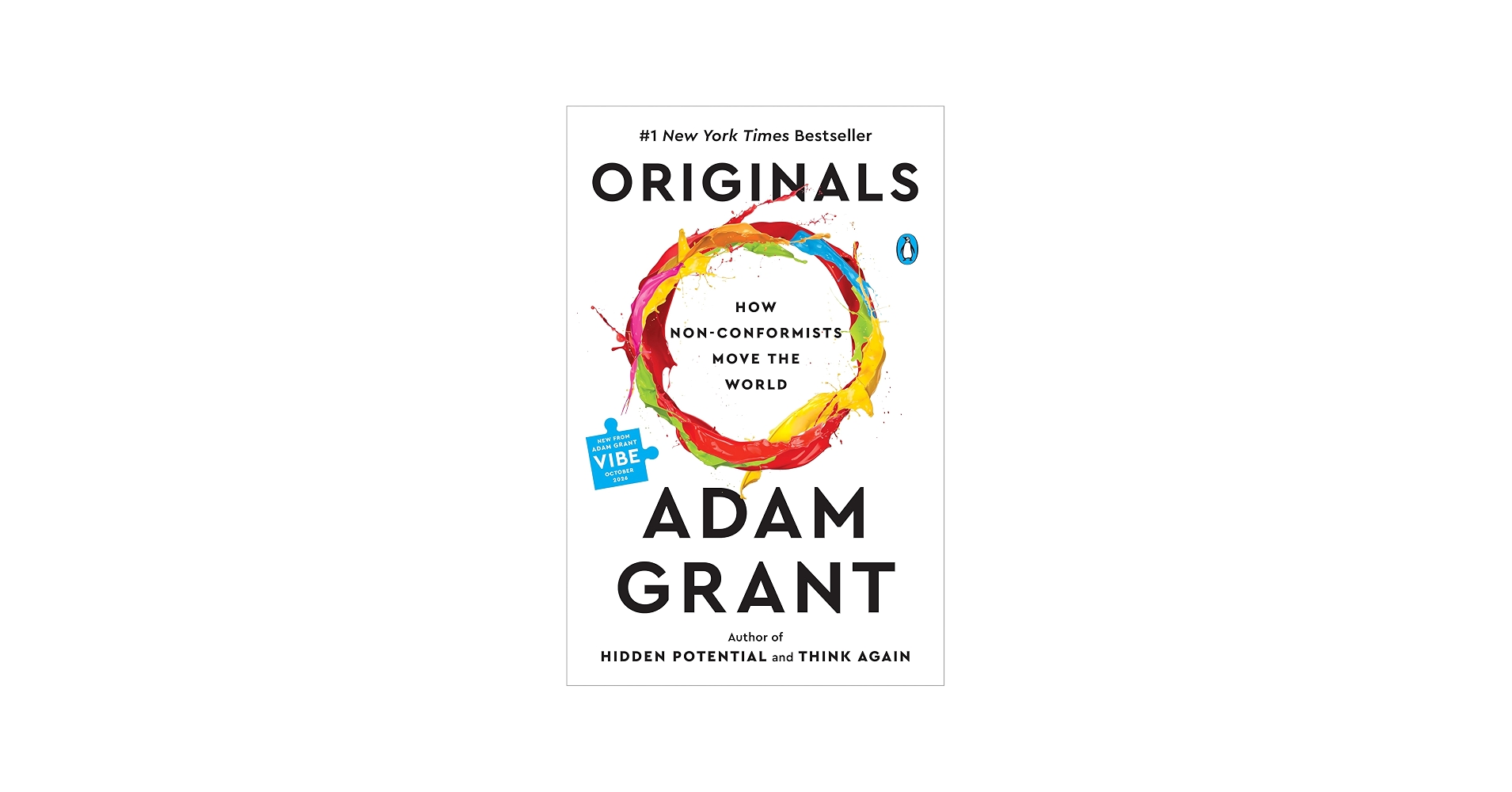
I actually read this book in 10th grade and wrote a book review. This is my heavily frankensteined and edited version of it.
In Originals: How Non-Conformists Move the World, Adam Grant argues that originality is something people develop through strategy, social awareness, and an understanding of their own thinking, and is not an innate trait reserved for a few. Using case studies and psychological research, he examines how people who challenge the status quo manage to have their ideas heard and accepted. The book is most persuasive in its account of the social conditions that make originality possible. It is least convincing when it turns to emotional regulation, where some of its advice conflicts with its central message about remaining true to oneself.
One of Grant’s most useful arguments concerns the relationship between risk and stability. In response to the question of whether day jobs distract people from their best work, he argues that security in one area of life gives people the psychological freedom to take creative risks in another. Many successful entrepreneurs and innovators, he shows, are risk-averse: they minimise risk in some parts of their lives so that they can take more calculated risks elsewhere. This challenges the common assumption that originality requires reckless, all-or-nothing gambles. By presenting originality as a matter of balance and strategy, Grant makes it far more realistic and approachable, since it removes the belief that one must jeopardise everything in order to do original work.
Grant’s discussion of credibility develops this practical view further. He introduces the concept of idiosyncrasy credits, the social capital people accumulate by first conforming to a group’s norms and showing loyalty, competence and reliability. These credits can later be spent to deviate from expectations without facing immediate rejection. The concept is not new in substance, since most people navigate it intuitively in social settings, but Grant articulates it with precise clarity and does not sugarcoat the reality of social dynamics. His account of the “Sarick effect” applies the same logic to persuasion. When presenting an idea to a skeptical audience, particularly one in a position of power such as investors, leading with the proposal’s weaknesses reduces suspicion of salesmanship and signals that the presenter has thought the idea through. Taken together, these concepts show that originality depends heavily on trust, both the trust a person has earned within a group and the trust they establish through transparency.
However, Grant’s treatment of emotion is less precise. In his discussion of peaceful protest, he distinguishes being angry at others, which leads to retaliation, from being angry for others, which leads people to seek justice and a better system. The distinction is interesting, but its framing implies that anger on behalf of others is less intense than anger experienced personally. In reality, people often feel deeper rage when someone they love is harmed than when the same injustice happens to them. The more meaningful difference lies in how that anger is acted upon. When people fight for themselves, their actions tend to be reactive and driven by a desire to relieve their own pain. When they fight for others, they consider how their actions might affect the victim and focus more on justice than on emotional relief. A distinction between fighting for oneself and fighting for others would describe this more accurately, as it acknowledges that the emotion may be equally intense while the motivation and method differ.
The most significant inconsistency in the book can be seen in Grant’s comparison of surface acting and deep acting. Surface acting involves displaying an emotion one does not feel, while deep acting involves changing one’s feelings by reframing the situation. Grant illustrates this with a flight attendant who, by imagining that a difficult passenger is anxious about flying or going through a personal crisis, comes to feel genuine empathy, which makes her warmth more convincing. He argues that this approach is both more sustainable and more effective. However, deep acting requires individuals to reshape their authentic emotions in order to accommodate others, and when practised habitually, it risks becoming a form of internalised emotional conformity. Grant criticises surface acting for being exhausting, but sustainability should also be measured by whether a person preserves their emotional integrity and sense of agency. His comparison to method acting in theatre also overlooks the psychological risks of the practice, which has been widely criticised for its effect on actors’ mental health, with Heath Ledger’s death after playing the Joker often used as a cautionary example.
Despite these weaknesses, Originals offers a thoughtful and practical account of how people can challenge conformity effectively. Its insights into risk, credibility and persuasion apply across school, work and everyday social life, and they give readers the tools to act on their ideas as well as the encouragement to think differently. Its shortcomings lie mainly in its approach to emotion, where Grant asks readers to adjust their inner lives in ways that the rest of the book gives them good reason to resist.



Leave a Reply