
Introduction
Over the last several years since its major engagement growth 2022, use of AI has been extremely successful in creating abstract art with over 700 analyzed articles and 44 studies showing that people generally do not recognize the difference between human-made and AI-made art (Okansen, et. al, 2025). Over half of AI generated art usage concerned visual arts, such as paintings and drawings, and one quarter concerned music.
People claim that AI art offers a wide range of benefits, from aiding in creative experimentation beyond traditional limits to allowing accessibility for art. They say AI grants us the ability to instantly form unique, customizable art which saves us time for tasks such as color selection and editing. According to Shalwa in “Exploring the Benefits of AI Art: Revolutionizing Creativity”, it democratizes artistic expression by giving anyone, regardless of skill or resources, the ability to create and share their work (Shalwa, 2024).
However, like every popular thing in this world, it sparks the contrary argument of negatives. Concerns rise about the huge part of film, traditional art, music, etc. being stolen from a young generation’s future opportunities, as well as AI’s ties to the multitude of issues that come with free, fake, and realistic generative creations.
Is AI likely to take over young artists’ careers? Is “learning” other artist’s beloved unique styles justified in the name of innovation? What’s stopping people from abusing this powerful tool? Will or should there be laws to control this surging new technology? Let’s dive into questions like these and investigate the fundamental context of AI art, why it is so controversial in our society, the realities of generative AI in our future, and the ethical limits of AI art use.
What is AI art?
First of all, what is AI art? According to Sheldon and Kerner in “What is AI art and how is it created?” it’s defined as any form of art created or enhanced with the assistance of AI tools.
The earliest instances of machine/computer-made art originated in the 1960s and 1970s, where artists like Frieder Nake, Vera Molnar, and Harold Cohen used computer machinery that drew abstract artworks from coded references to real-life forms (MoMMA, 2025) .
Fast forward a few decades, AI art has evolved to mimic human styles, respond to prompts or emotions, collaborate with human artists, and create 3D visuals with animations.
Leading AI image/art-generative companies like Midjourney and OpenAI transform prompt input (ex. text and other images) into codes a computer can process, before being refined by network models to improve accuracy in the final art piece ((Tosh Marketing, 2025); Vass, 2024).
This is how AI can “learn”; if you input the correct data, it will analyse and copy them for reference in its works, and their models will improve further upon that.
Interestingly, the first AI innovative art wasn’t meant to best humans—it was more about experimenting with code itself. The original purpose of generative AI was to “learn data patterns and construct realistic outputs, not to create art; any ‘creativity’ it produces comes from humans,” as stated by Ian Goodfellow, the founder of the Generative Adversarial Network. GAN was one of the first technologies to learn patterns on a large dataset, digitally producing and improving upon its works.
Why is it so debated?
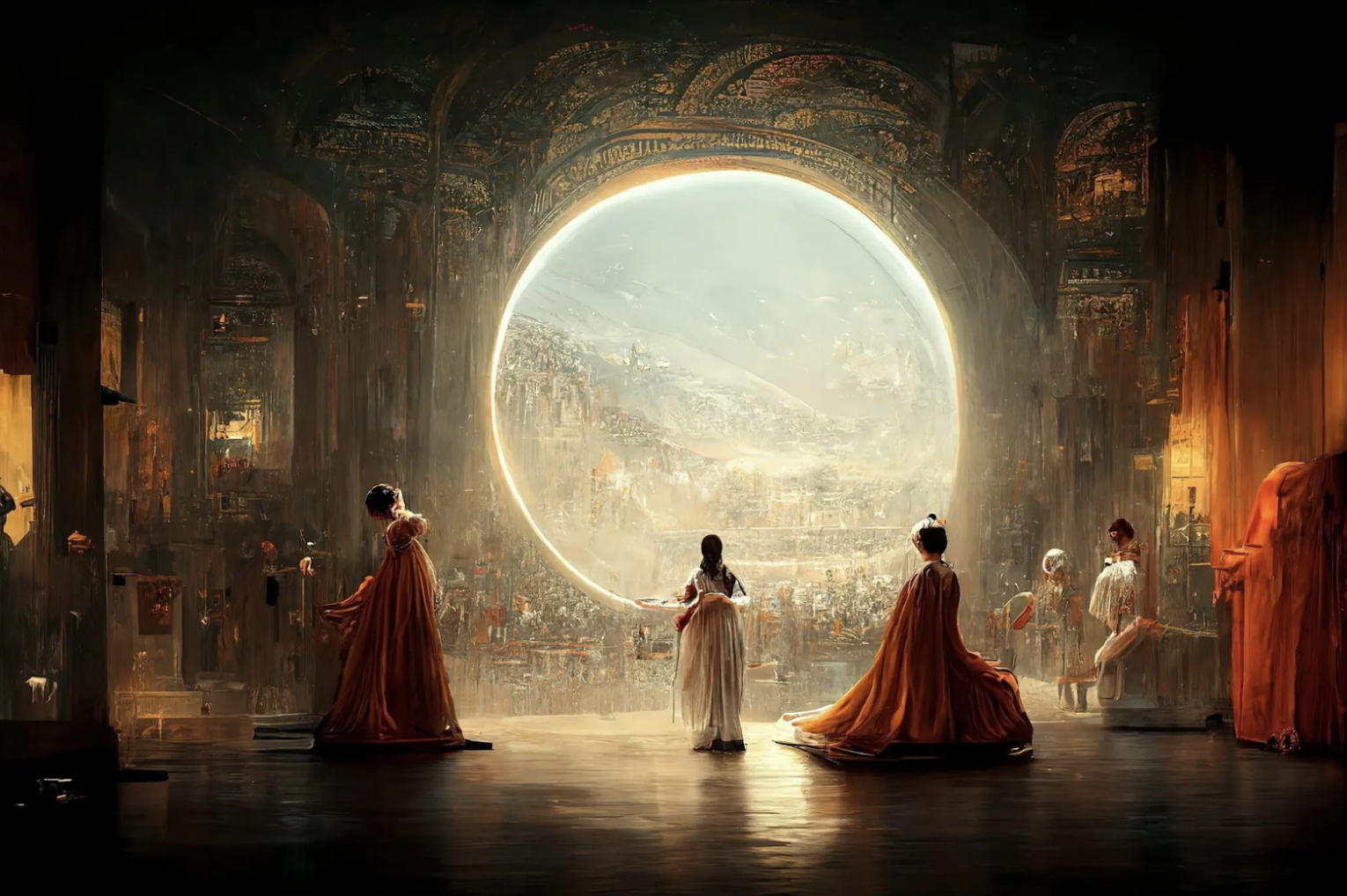
The problem is, of course, if you could best humans with innovative AI, then people must use or take advantage of it. There have been multiple competition incidents involving AI art, including a case where someone won first place, winning $300, by entering an AI-generated image in the “digital arts/digitally-manipulated photography” category at the Colorado State Fair Fine Arts Competition. The “Théâtre D’opéra Spatial” made with Midjourney caused people to question AI’s place in the creative field. The submitter himself, Allen, defended that it was more than just putting in a text prompt. He stated that it took him more than 80 hours of specific techniques and improvements in his instructions.
Still, many people believed that his entry was invalid, commenting “This sucks for the exact same reason we don’t let robots participate in the Olympics” on X, while another says “This is the literal definition of ‘pressed a few buttons to make a digital art piece’” (Metz, Rachel, 2022).
Another perfect example of ethical, legal, and contentious content controversies of AI art is the Studio Ghibli incident. Earlier this year in March of 2025, a new AI art trend arose in OpenAI’s ChatGPT that allowed users to simply upload an image onto the platform and request it to be rendered in the style of Ghibli within seconds.
Studio Ghibli, founded by the legendary illustrator Hayao Miyazaki, is famous for its specialized hand-drawn animations that captured human experience and soul into award-winning movies such as Spirited Away and The Boy and the Heron, all taking years to produce. But with this new trend, which was largely supported by OpenAI, millions of images were generated copying Ghibli’s style including insensitive pieces such as the twin towers falling, George Floyd’s death, and the official White House account on X’s image of an agent detaining Virginia Basora-Gonzalez for allegedly dealing fentanyl.
It resurfaced Mr. Miyazaki’s previous disdainful statements on AI when he called artificial intelligence in animation “utterly disgusting” and “an insult to life itself,” wishing to never incorporate this technology into his work at all. As a design and animation academic, Deborah Szapiro put it, OpenAI is not just copying Miyazaki’s work, they’re stealing it. She argued that AI could never capture the heart and essence of his art, and that the technology is exploiting the comfort and beauty of Ghibli films for profit, especially for people who grew up with them. AI-generated work also contrasts with Miyazaki’s films that focus on environmental and humanistic themes, while AI production consumes significant energy.
Furthermore, this situation of OpenAI’s ability for users to create these replicas aroused arguments regarding copyright infringement. One intellectual property lawyer noted that no legal case has yet tested the boundaries of AI-generated art. OpenAI could argue for “fair use” in the US by claiming that its AI was trained on multiple sources and transforming the original works. In Australia, however, their stricter “fair dealing” laws typically allow reuse only for news or research. Unforeseen complications could arise from agreements with image libraries or platform licenses, and the internet makes it easy for creators to lose control over their copyright.
Is AI likely to take over artists’ jobs in the future?
As of 2025, there already has been numerous evidence of artificial intelligence replacing illustration and graphic design. In early 2025, after the UK Government launched a public consultation on Copyright and AI, the Association of Illustrators (AOI) polled its members. The results showed that more than 32% had already missed out on jobs because of AI, with each impacted illustrator losing an average of about £9,262, around $12,180 USD (Cartwright, James, 2025).
A survey from Society of Authors in 2024 also showed that 26% of illustrators already report losing jobs to AI-generated art.
The article “Image Generation: State-of-The-Art Open Source AI Models in 2025” states that AI has significantly improved in generating highly photorealistic images, follow complex prompts accurately, perform style transfer, and fine-tune styles with very few example images. Their new models now include FID 2.12 (image quality) photorealism, 92% prompt accuracy, and style fine-tuning with just 10–20 images.
In just three years since its release, the top AI art generator Midjourney was able to go from generating simple images to creating hyperrealistic and complex AI videos. In July of 2025, Midjourney posted their brand new V1 model on YouTube showcasing strikingly lifelike, dynamic animations of landscapes and creatures.
“I think the market will go towards higher quality, more creativity, and vastly more sophisticated, diverse and deep content,” David Holz (the CEO and founder of Midjourney) explains. “And the people who actually are able to use like the artists and use the tools to do that are the ones who are going to win.” (Kessler, Ana, 2022). 89.6% of artists surveyed on AIPRM also say that text-to-image AI will likely have at least somewhat of an impact in the future of art, whether that be negative or positive.
However, according to an article, “AI art in 2025: What’s real, what’s hype, and why Everyone’s arguing about it,” generative AI currently lacks essential elements of intentional design, narrative consistency, and emotional storytelling in their art. For example, designing a world with a unique cultural identity or visual style can’t be fully captured by a simple AI prompt. Artists depend on lived experiences, design knowledge, and personal source materials that an AI might overlook or not even have access to. Misinterpretations by AI are really common, which makes it challenging for the people to achieve the exact vision they have in mind.
Additionally, AI has a record of being legally and ethically messy when used; like with the Studio Ghibli incident. The problem with using AI for creating and selling art is it could easily violate copyright issues when it generates images off of a huge, largely unknown database to train its references, techniques, context, and style. Millions of artwork online could potentially be used without the creator’s permission. As a result, it causes a complicated ambiguity as the artists sue for compensation from exploitation without consent.
Yes, there are plenty of artistic nuances to generative AI, but the most important question for dreamers wishing to enter this field is how the people are responding to this new emergence—in business, design, commissions, “creative” expression, and much more.
According to Artsmart AI, 29% of digital artists are using AI in their work; a significant adoption rate within the digital art community. However, this does not mean that they all use AI to create 100% full creations; only around 11% of the digital artists do this, and less than 8% show this work in art venues. Generative AI also is implemented in industries such as fashion, automotive, and technology to speed up how they design new products. When companies give the AI a few details, like the size, weight, or material they want, it can instantly create many different design options. It replaces the need for design teams to develop thoughtful and carefully planned ideas.
With that said, previous evidence obviously shows that AI art has faced strong public opposition in certain major areas. Like when an AI-generated image won a digital art competition, which many compared to letting robots compete in the Olympics. There was another, with the widespread copying of Studio Ghibli’s style, including insensitive images, which drew public criticism for disrespecting the original art.
In a survey by KOAA, 76% of people do not consider AI-generated works to be real or “genuine” art—and 70% still believe that AI will not be able to create art that carries the same emotional depth as human-made art.
Should there be laws or rules to control and prevent AI abuse in art?
So: where do we go with all this?
Well, it’s clear that the main concern is on the ethical/legal copyright and impertinent generative AI use. While there is also fear of it overturning careers, that one doesn’t cross any jurisdictional boundaries. What limits or policies are missing that allow the misuse of artificial intelligence? What rules ARE already in place?
Currently, generative AI does not have a direct copyright law in which people can take compensation for their works’ contribution. This is because it is trained on existing works without permission, so courts have not tested whether that counts as fair use. The Copyright Office requires human authorship, leaving AI outputs legally uncertain.
Many AI art companies like Midjourney have terms and policies that ban violent, harassing, adult, or real-person deepfake content, as well as IP violations and unauthorized automation. If violated, your account could get banned, the content would be removed, or in severe cases legal would be involved. They enforce this using filters, human moderators, and account bans, with free trials once paused due to misuse. But a lot of individuals can still merely ignore policy, switch to a different platform, or leverage a work around to continue without much consequences.
If legal action like fair use could be navigated and cleared in the future, there are a few ways to stop AI from misusing artists’ work that some experts have suggested so far. One idea is an opt-out system, so artists could block their work from being used in AI training. Careful consideration of stronger laws focused on data protection would also give more direct control over how their pieces are handled. It accomplishes things copyright laws can’t fully cover, like preventing exploitation.
(The Regulatory Review, and Cross Conrad).
Conclusion
Artificial intelligence has grown significantly over the past few years, to the point where people can’t tell what’s fake and real anymore. While this technology can allow anyone to expand creative possibilities or save major time in production design or media, it also raises serious ethical and legal concerns. People are angry because of its issue with potentially “stealing” works, taking futures or jobs, and inappropriate representations of sensitive topics. And while AI can mimic to the very last detail or create complex visuals, it still lacks the emotional depth and contextual meaning behind human art. As debates keep pouring out for fair compensation or limits, it’s clear that society must find a way to embrace yet control this useful tool to protect rights and the meaning behind art.


Leave a Reply